Even though I am in the middle of a very interesting exploration into the Australian gothic, I have had to press “pause” and tidy up. All because I need a nice succinct definition of the gothic, the Aus gothic and then the connection to my poetry.
It’s hard to be succinct when there is paper everywhere.
Yes. I am one of those.
A tactile, highlighting, annotating, scribbling researcher. I can read a screen just fine and even take notes from a screen when required but I would prefer to have it on paper, in front of me.
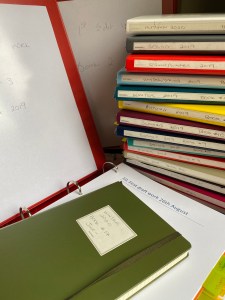
I got rid of our lawns and planted a native garden as a means of giving back to the planet and I recycle! First in my study—using both sides of my paper—and then again through the recycle bin. It isn’t much, I know.
But, you see, I think better when there is a pen in my hand and a piece of paper in front of me. I’m up to nineteen fully filled personal notebooks. They, of course, won’t be recycled in my lifetime.
Imagine how many I might have by the time I die…
Anyway, back to the paper. More accurately, back to the need to tidy.
One simple definition keeps eluding me simply because there are too many articles, notes, post-its, and empty folders. The chapter is crowding in, wanting to be written all at once. All of these ideas want attention and notice, and want to be articulated on the page. There is an urgency to their noise that is distracting.
So I have sorted them into their place in my folders; notes in the front, articles between the dividers, books stacked according to current use. I found a couple of articles for chapter 4 that think they can be a part of chapter 3. I’ve put them in their folder on the shelf to wait their turn—they shouldn’t have to wait too long.
Now, I can breathe.
And I found the thing I was looking for. The excellent introduction to Fred Botting’s Gothic (2013). It begins by establishing that ‘A negative aesthetics informs gothic texts’ (p. 1) and goes on to say that ‘Definitively negative, gothic fictions appear distinctly anti-modern in their use of the customs, costumes and codes of chivalry associated with feudal power: the gallantry and romanticism of knights, ladies, and martial honour also evoked and era of barbarism, ignorance, tyranny and superstition’ (p. 2).
Ah, that is much better. Now that I can see the top of the desk again, I can think better.
I suppose I’d better go and write that definition now that everything is tidy again…
Botting, F 2013, Gothic, Taylor & Francis, London.

 This Writer's Life
Wonderful post 👍
LikeLike