If you are more interested in your research than in your writing, this might help you find a way forward.
All PhD students have to write. It’s par for the course. Some of us love that aspect of it and some of us are terrified of what seems to be an impossible word limit.
Here are some tips for those of you feeling overwhelmed. This isn’t an exhaustive ‘how to’ but more of a ‘help you get organised’.
Do your reading
It should go without saying that while you are gathering your data—with whatever methodology you choose—you are also reading up on your topic. Research broadly and mine the references in those papers.
Reading has two basic benefits.
- It will positively impact your writing. You will begin to unconsciously take on the style of academic language and writing.
- You need to know so much more than you are going to say. You need to have found counter arguments, theorists you don’t like, writers you do, etc, as this will inform your thinking. You can’t discover something new if you haven’t read what is out there.
Annotate and organise those readings.
Whether it is folders on your computer or folders on your shelf, figure out a way to manage the information you are taking in.
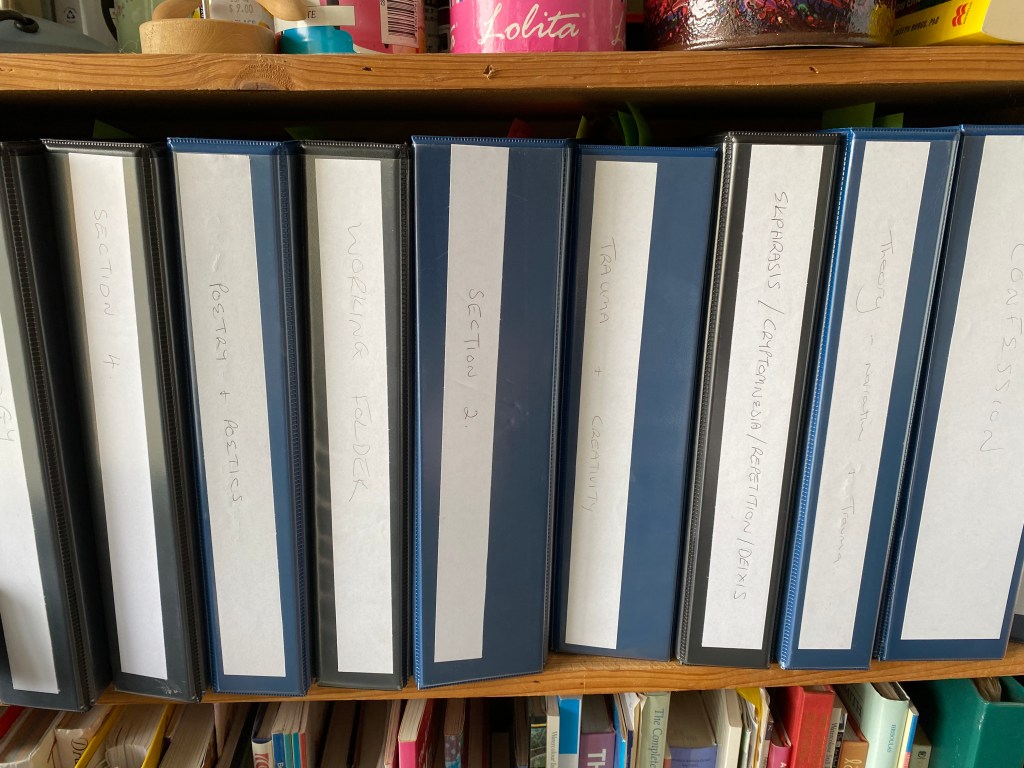
I personally attach all pdfs I can generate to my references in Endnote as electronic storage. And I print and store them in actual folders on my shelf. Yes, I do feel a pang of guilt for the environment but I can’t dismiss my learning style (and have no intention of throwing away these lovely friends of mine)
I am a tactile learner. I need the paper in front of me so that I can highlight and annotate. The folders are labelled according to loose groupings and every now and again I do a re-sort to accommodate a new direction in the research.
Wherever you are storing the papers you are reading, find a way to annotate them as you read them.
This is important: highlight what seems interesting and relevant but don’t treat it like a colouring book. Not everything needs colouring in.
Take your notes.
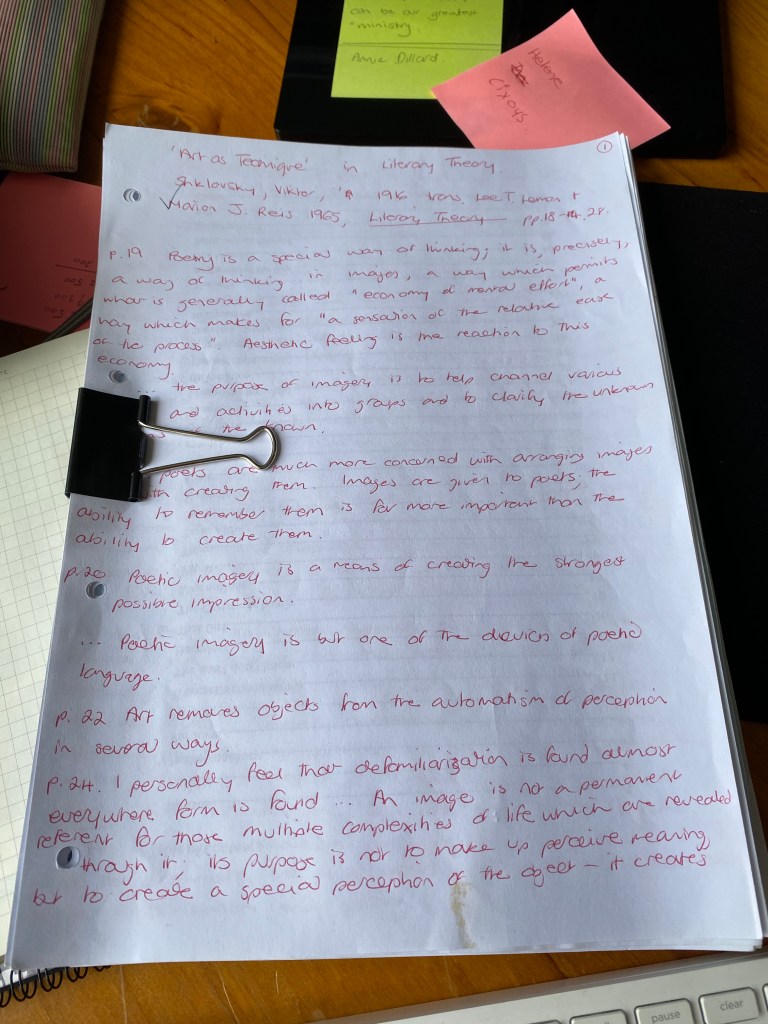
The pen rule: use two different colour pens and stick to it.
Blue/black for your words, red for anyone else’s words.
We all know it is super important not to plagiarise but you also don’t want to plagiarise by accident either.
When you always write other people’s words in red and your own in blue/black, you know what belongs to you and what doesn’t. This works on a word processor just as well as it does on the page.
This might be where my note taking diverges from the standard meaning (of me only using my own words). Yes, I am writing down my ideas but when I am preparing to write, I need to know other people’s ideas, too.
I go back to the papers I have read and write out the quotes I have highlighted. I write the full reference at the top of the first page of notes as this makes referencing easier later. I begin the quote I am using with the page number of where it is in the paper. I number each page of my quotes and start the subsequent pages with the author’s surname and publication date.
What I end up with is a pile of quotes about the things I want to cover in my chapter and enough information with them to enable me to correctly reference right from the start.
Once you have your pile of red notes…
You’ll need to read through them and highlight those quotes that seem the most relevant. You are looking for the things that really support what it is you want to say, and for things that can connect your ideas together. And for anything that sounds snazzy or pops. (Let’s not have boring academic writing, shall we?)
To plan or not to plan?
I generally have a list of topics I am going to cover and the order I am going to cover them in. But I don’t want to be so rigid that I miss something interesting that comes up. I remind myself that plans can change
Once I know where I am heading, I tend to use my quoted notes as stepping stones through my topic, rather than writing a detailed plan.
Getting started with the writing.
Just start. Open a document and save it with an intelligent name.
Write a crapy introduction or leave the introduction until later. Use an epigraph, or don’t.
Find your first point and say something. Aim to make your topic sentences concise. You have the whole paragraph to explain what you mean.
Do try to keep things formal and avoid starting each sentence with ‘I’.
Using your quotes/references
Pretty soon into that first paragraph, you are going to want to prove your point and show just where your thinking came from. I prefer to quote where possible but you can reword what someone else has said and simply give credit.
Quoting has the advantage of plumping out your word count and making you look totally smart (which, of course, you are). Also, quoting allows for you to interact with the ideas that other people have had and add to them.
You are not a lone wolf when it comes to research. Your research always rests on the back of someone else’s. What you are aiming to do is add your brick to your particular wall of knowledge. That way, someone can rest their research on what you have discovered.
Write as best you can
Even though you might only be working on a first draft, do it as well as you possibly can. If you are going to leave something for fixing later, type that intention in caps lock and highlighted it some ugly colour so that you will remember to come back and fix it.
Your first draft will always need work, but you can make it easier for yourself. That’s why you want to reference correctly as you go. At the end of each writing session, finish by adding what was used to the Reference list at the end of your paper.
Creating a habit of writing
There is something to be said for developing a habit of writing. Even if it is just the minimum you know you will do, say a paragraph here and there.
Once you have started with your habit, your writing fitness will improve. You’ll find the whole process of gathering notes and writing them up will go a lot faster.
Handling feedback
Your supervisor is there to help you. They want you to do your very best. Even if you disagree with their feedback, still take the time, when you are calm, to consider it. They might actually be helping you learn something.
And whatever they suggest in relation to improving your writing, do it. Don’t defend bad writing just because your pride is hurt. When my supervisor pointed out a flaw in my thinking, I took what he said seriously and discovered that I had developed a conformation bias that was starting to creep in. Yes, it hurt. But I would rather my supervisor say it than my assessors!
By the way, don’t get just anyone to give you feedback on your paper. Not everyone understands what it is you are doing.

 This Writer's Life
Great advice Shelly. I’ve never written my thoughts in blue or red. What a great way to prevent an accident with plagiarism.
LikeLiked by 1 person
Thanks, Libby. It really simplifies things as you know exactly what you are looking at.
LikeLike
Enjoyed this insight, helpful and fun – so glad you’re doing this Shell, you’ve got a gift
LikeLike
Thanks, Danny.
LikeLike