An email arrived from my supervisor, ‘call me when you can (nothing bad)’. He answered the phone with ‘have you been watching your email?’.
I had been. That’s what happens when you are waiting for news.
He talked me through the process and the assessor’s reports. Then we spent time reflecting on what an amazing three and a half years it has been.
A recap on the journey
I officially started my Higher Degree by Research, a PhD, in June of 2018 as a part time student. Right from the outset I knew I wanted to produce a collection of poetry. I began familiarising myself with the academic expectations, completing the foundation academic requirements, and writing poetry.
Right from the beginning, in my first submission of poems, there were poems that would make it all the way through to the final collection. While I struggled with the ‘not-knowing’ of the first year, I threw myself into the project so I could ‘find out’. By colloquium in September of 2019, I had my research question ‘how does poetry allow trauma to speak?’.
Almost to the day of sitting colloquium, my dad died, a strange and surreal situation. I worked through it in the poetry, writing a series of ‘black bird’ poems. Immediately after colloquium and in the face of this strange loss, I experienced a create surge, producing numerous quality poems in a short period of time.
All the while, I was progressing with the academic reading, fueling the creative product and forming a strong foundation for the exegetical writing. By the close of 2019, the collection had come together.
At the start of 2020, I took long service leave to see if I could crack open the beginning of the exegesis. I read copious amounts of poetry and critical essays, and began to write the exegesis.
My first go was just that, a first go. No references, just ideas forming themselves in to 2000 words. My second go took me a little closer. Things clicked on my third go, an initial draft of the chapter, ‘The psychology of child abuse and the partnership of poetry in recovery’.
What I discovered in that chapter was my own process. I learned how I liked to take notes, pull them together, and write them up. You can read about it in the post How to get started writing an academic paper. Once I had my process, it was a matter of rinse and repeat.
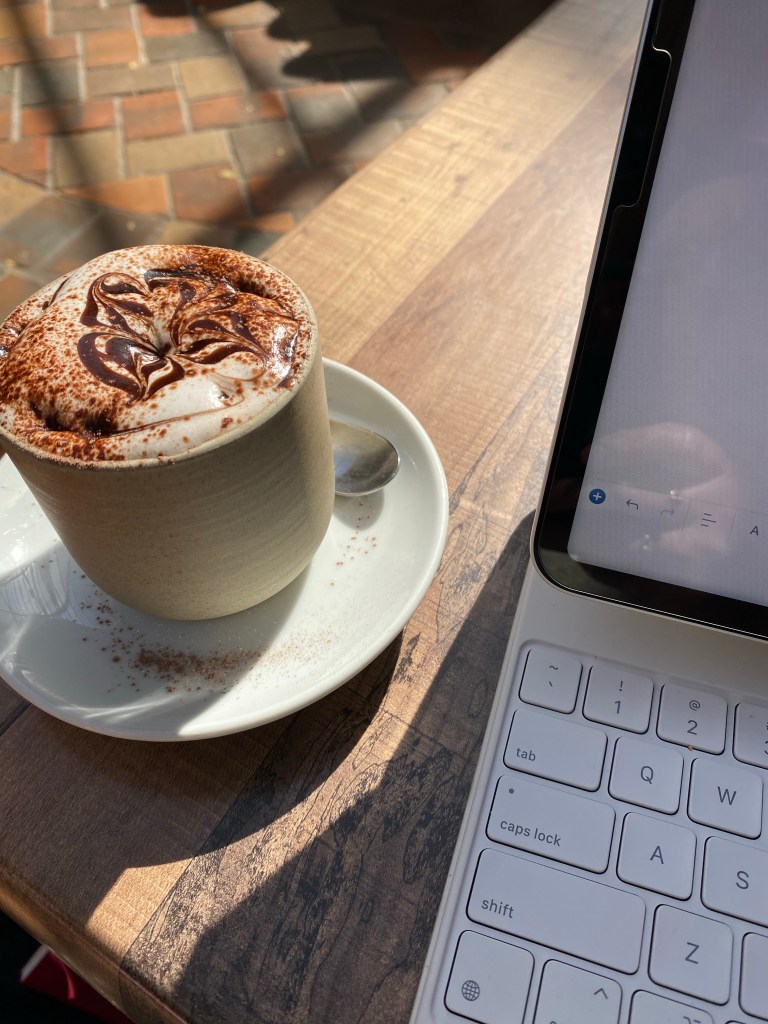
Of course, in March of 2020 Covid arrived and the world went into lockdown. While unsettling, the research continued unabated—my life was already very quite. Lockdown just took it one step further so that now I couldn’t go out to the coffee shop to write (a favourite writing place of mine). However, I had my process to lean into and work to do. So I did.
The chapter, ‘Bearing Witness to Suffering: The individual witness of practice-led research and the collective witness of literary trauma theory’ came together in three months.
The longest chapter (16,000 words) analysed and expounded on the what the poetry revealed. Called ‘Finding the words: How poetry allows trauma to speak’, this chapter flowed. While it revealed unexpected things, it was also an enjoyable time of looking at my own writing in an objective and removed manner. My writing fitness was high with this chapter.
In 2021, I began writing the final chapter, ‘Confessional Poetry: Trauma that Speaks’. My supervisor and I both assumed that this chapter would flow without difficulty (as the previous one had). We were wrong. Applying my theories to the poetry of Sylvia Plath triggered a trauma response in me much like tectonic plates moving, a few trembles are felt on the surface while what is happening deep within doesn’t show itself until later.
I kept tangling myself up in my approach to Plath’s writing, analysing the poet rather than the poet persona. Several major re-writes later, I figured out what was going on and was able to separate myself from the suffering she explores. Thankfully, I believe that words are limitless, so if these one’s don’t work, there will always be more.
In mid 2021, I slowed the project down. It was clear that I was going to be ready to submit right on Christmas time—no one wants to assess a dissertation while preparing for a time of celebrating family. So I waited until Jan 2022.
And my results arrived in April.
What the assessors said
I found this to be an exceptional thesis, both creatively and in terms of its exegesis, and am pleased to pass it.
Assessor one
And this.
It marks an important intervention into scholarly and creative thought and should be award the degree forthwith
Assessor two
They both then indicated that their feedback was in relation to publication and offered insightful and helpful suggestions that I am grateful for. I am particularly encouraged to read that one assessor thought that
The readings of Plath’s Ariel in the context of confession, however, are brilliantly executed, and put the reader in mind of the thesis’ poetry, with fresh insights offered on these poems.
Assessor one
But mostly, I am encouraged to continue to pursue publication of the poetry and to see that there is something here worth sharing, something that is saying what needs to be said. I have read the following over and over.
The creative component of this thesis—a poetry collection, ‘Finding my Mother’s Daughter’—is a professional and impressive piece of work. It grapples with explicitly personal and confronting subject matter but does so in a way which skilfully enacts a constructed or crafted metaphorical ‘pattern of behaviour’ that is able to house and manage material that would otherwise be overwhelming.
Assessor two
What is next?
Well, I still need to follow the administrative processes of the university before I am ready for graduation. If I get to be part of a graduation ceremony, that won’t be until October. I am really hoping it will go ahead as an in-person event.
I am also sending poems out for publication, and will continue to do so. Likewise, the collection, with a little punctuation tweak here and there, will continue to go to publishers.
I’ve also started looking into academic publication and expanding the exegesis into a book. One way or another it will be published as either a book or a series of articles. At the moment, I am working on the book as I have some strong ideas for how to expand the current framework.
Publishing takes time. It is a highly competitive market that requires a degree of luck as much as anything. Just look at all of the books on the market already! And it’s not like poetry is the most popular genre out there.
I won’t consider self-publishing the collection for at least two years. I want to give it my best shot to get this work into the hands of a publisher. There are some strong advantages to being published through the industry (particularly around selling the work). I am open to self-publishing but not until I have exhausted all other avenues.
In the end, the work is important, even if I don’t see its impact in my lifetime. Plath did not see Ariel in print. She had no idea that almost 60 years after her death, the world would be obsessed with her words.
I’m not saying that I am on par with Plath—goodness, not even close! But what I am saying is that publishing isn’t the mark of success. Writing is.
The work is written.
Shortly, it will be stored in a place where future researchers can find it. It has been crafted to the best of my ability and offers new thoughts and insights into the partnership between poetry and trauma.
What happens next is what is meant to happen.
But nothing can happen if I do nothing. I will do my best to see this work is made available to as many people as possible but I will not feel I have failed if, in my life time, that doesn’t seem to be very many.
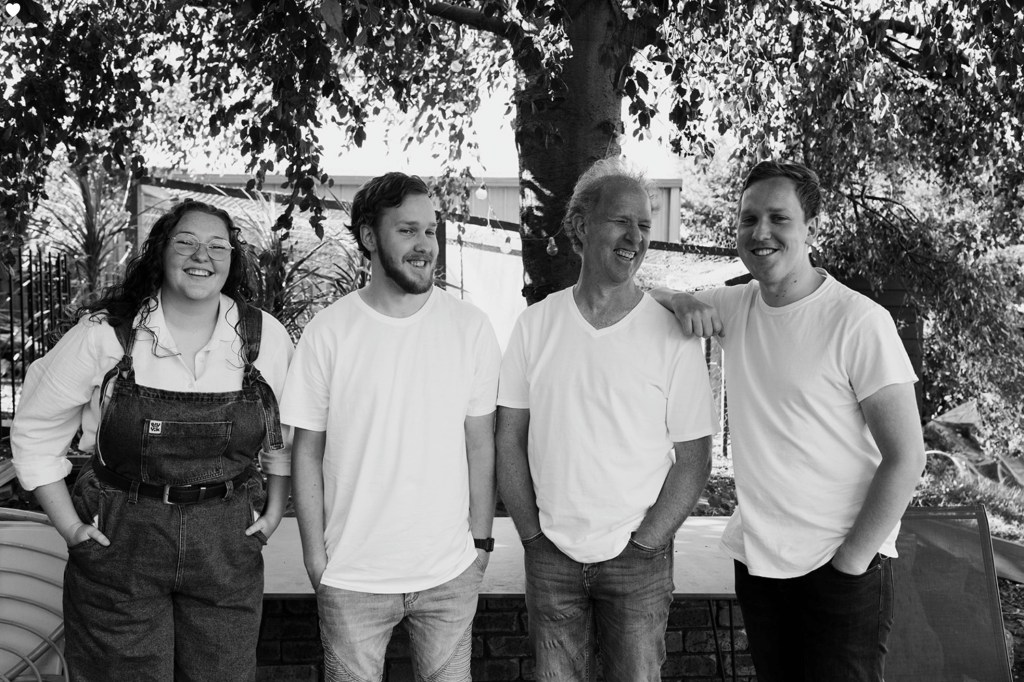
In reality, this project is a legacy for my children. They will know where they have come from and will continue the work of overcoming generational trauma.

 This Writer's Life