
My job as a teacher is to help students unravel the mystery of their lives. I notice things about them, help them be brave, to listen to their hearts, and encourage them to take chances.
Before any of that can happen, students need to get out of their own way. The misbehaving student, no matter how pleasant a person, is putting their energy into the wrong things. Helping them to know and understand boundaries is key to moving them beyond this unproductive holding pattern.
If students don’t move beyond a pattern of misbehaviour, they tend to develop a victim mindset, blaming others for unpleasant life experiences. Living life to the full requires a student see and understand how their current behaviour can be overcome.
This stage is hard work for a teacher. Being consistent and understanding without getting frustrated is a big call to make for anyone, let alone someone who is trying to provide learning opportunities to a group of students while one is working to interrupt this learning opportunity. I find I can be patient for quite some time and then break.
When I break, it is often with a direct truth-telling moment that is unpleasant for the student. I have learned to avoid name-calling and to be careful to keep controversial opinions as private conversations, but I still fail in that my own peace is lost.
Often this moment of breaking signals a turning point in the relationship. Students either hear the frustration and decide to change, or they don’t.
Earlier in the year, I had a student who had been consistently misbehaving make a public accusation about my work habits. It hit a nerve. And I responded with some direct truth-telling.
I was sure that the relationship was done for, but when the student returned next class, he behaved as if he understood me as a real person. He was less critical and more considerate. I didn’t make a fuss but got on with the next stage of helping this student unravel the mystery that is their life. I continued to design learning activities that I hoped were engaging and interesting for him and others, and I took specific opportunities to call on this student in his areas of strength. I made sure to notice when he was trying and to see the good in him. I let go of our “moment” and moved on.
It is only by experiencing a range of things that students can begin to differentiate between what works for them and what doesn’t. Accepting what doesn’t and moving them on with either ‘we all have to do things we don’t like’ or ‘that’s okay, not everyone is good at everything’ is an important life skill..
As students’ confidence grows, they take more risks, and as they take more risks, they have more opportunities to find the thing that lights them up. I’m not talking about risks like driving fast or taking drugs. It is risky in the classroom to raise your hand and ask a question. It is risky to try to write a sentence and say the thing you mean to say.
Classrooms are dangerous places for teenagers.
As teachers, it is our job to make them safe places for everyone. This brings us back to the need to manage the disruptive student. They might be having a terrific time in their own little world without realising that they are stealing safety from others.
Building confidence in students takes a long time.
They are afraid, like all of us, of looking foolish. The worst situation is when a student tries something, finds they like it, but is shamed by someone. This creates a difficult dichotomy that can lead to an internal sense that because they like a certain thing, they are a bad person.
Teachers are powerful people. Shaming a student, while a human thing to do, is to be avoid at all costs. Truth telling can sometimes appear as shaming when a student has shame embedded in their sense of self (often from earlier shame-based experiences). This is when restorative conversations need to reiterate that, as a teacher, you are wanting the best for them and helping them to move past behaviour that is holding them back.
So easy to say when calm.
Press my buttons and I am going to say it in a highly articulate, direct, straightforward, frustrated type of way.
I do try to avoid those situations but sometimes it is what it is. Sometimes students need to see that you have had enough. So important, however, not to name-call, not to shame. And so hard when some kids, usually those kids who desperately need life restored to them, hear things through a shame filter. Still, it is my responsibility as a teacher to always be thinking about how I can help students move forward.
Life is a mystery to unravel, even for those of us not figuring it out for the first time. Mysteries are exciting, they are engaging and fun, and they are what life is all about.
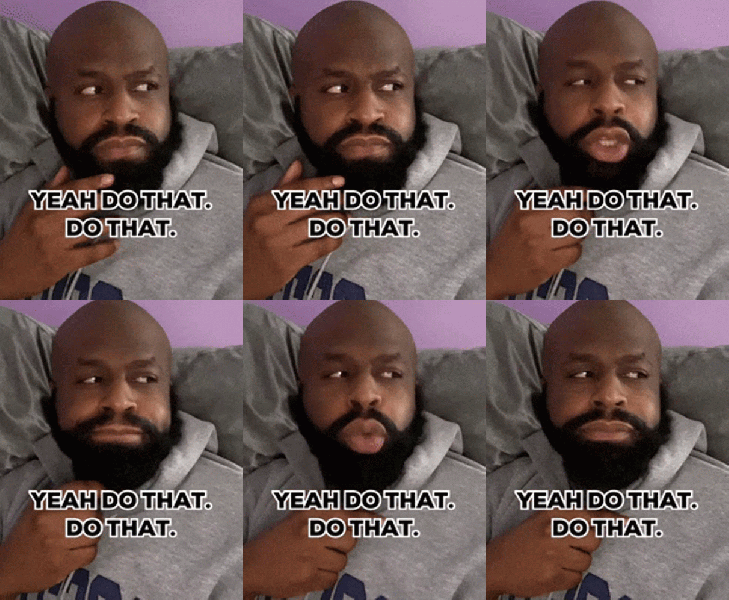
What is it that captures your interest? That lights you up? That makes you smile?
Do that.
It will be a little thing, by the way. Big things are a result of lots of little things, just ask Paul Kelly. He’ll tell you that ‘from little things, big things grow’.
The little thing will be the way you liked to put band-aid’s on your teddy bears and take them to hospital on the back of a tip-truck. The little things will be the way you notice someone else. Yesterday, I felt unwell in my final class of the day. I warned the kids that I was feeling unwell. One student raised his hand and asked ‘is it mental?’. I was completely confused. He explained that they had just done a Mental Health First Aid seminar and that it was important to check on people’s mental health.
I wonder about this student.
He is kind and caring. He has learned how to learn. He is writing in ways that he finds surprising and I find delightful. These are all clues to the mystery of his future, the mystery of who he is. Will he go into a caring profession? Will he write about caring? Will he use his writing to excel at a university degree? So many things! Things that until this year, he was unaware he was capable of. Yes, at the start of the year we worked through his behavioural choices, but it was easy. He had grown tired of misbehaving and wanted to engage in his learning. He decided it was time to stop limiting himself. And he felt brave enough to try. He felt safe.
What is the mystery of your life?
For me, it is understanding and articulating what I do as a teacher.
But it is more than this. There are different aspects to my life. Teaching is just one part of what I do. Some things are harder than others. Some don’t work out the way I hope. Some doors close despite me jamming my foot in the doorway.
And some doors open.
Babies are born—Grandbub has a tight hold on my heart—and poems get published.
I hope that even in death, whenever that is, I will still be excited to unravel the mystery of those last few breaths.


 This Writer's Life
What an absolute pleasure to read.
LikeLike
Thank you! Xx
LikeLike