It has been days since we finished the Overland Track and I am still dreaming that I am sleeping on the track amongst the rocks—not something I actually even did while we walked.
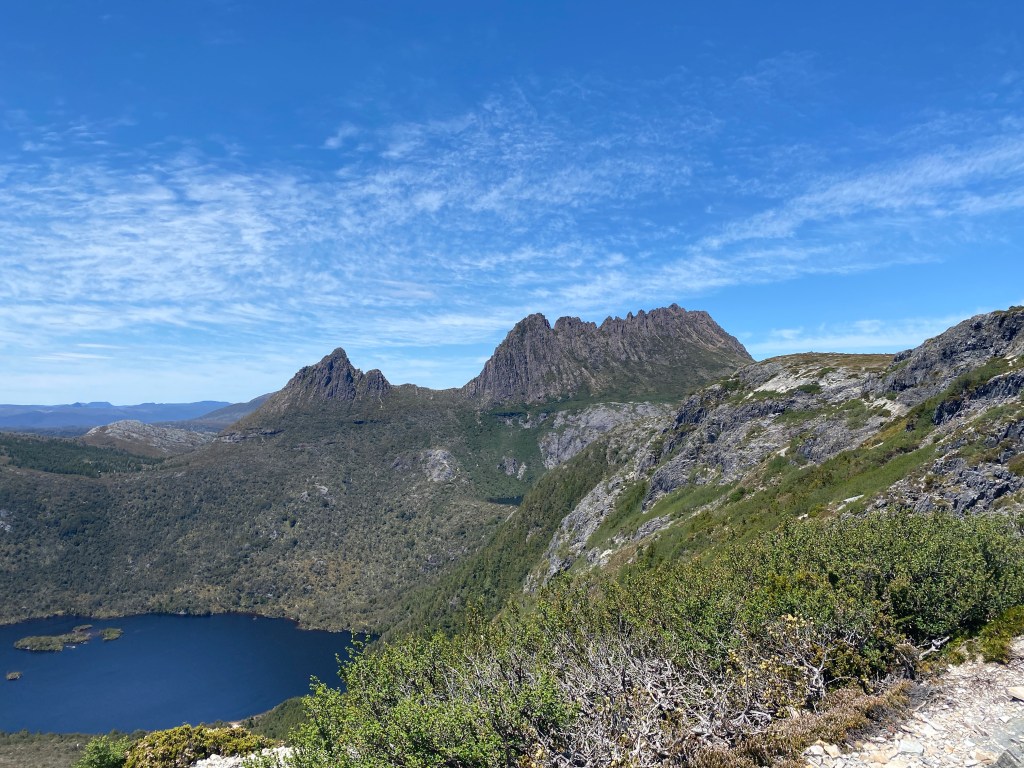
Our first day was one of three of my hardest days hiking. Climbing out of the Lerderderg Gorge on an unmarked track on a scorching bushfire-risk day and the day I broke my leg on the Razorback on the way out to Mt Feathertop are still my top two for rubbish days on the track. But this first day of the Overland now ranks as a close third.
It was hot.
So hot that the heat was radiating off the bare track on the rise up to Crater Falls at 9:30am. Cradle Mountain gets 4.3 days per year above 30°C. The temperature reached 32°C by 1pm and stayed there until 5pm. (Thanks, Daughter, for these helpful stats).
Climbing Marion’s Lookout is testing at the best of times. It isn’t that the climb requires special skill, it’s that you are carrying your pack at its heaviest. You are full of hope and adventure—off to walk the Overland! This toxic positivity needs to be smacked out of you so that you don’t make some dumb mistake that results in your body being airlifted while your soul stays behind.
When you make it without incident you don’t believe it can be any other way but it can. Plenty of people have died walking through the wilds of Tasmania. Most make it with a few blisters, possibly a pulled muscle or two, sore legs, and always happy chatter about the things that have happened, the things they have overcome on the track.
The risks seem non-existent when the results of the risk are not encountered. It doesn’t mean they aren’t real.
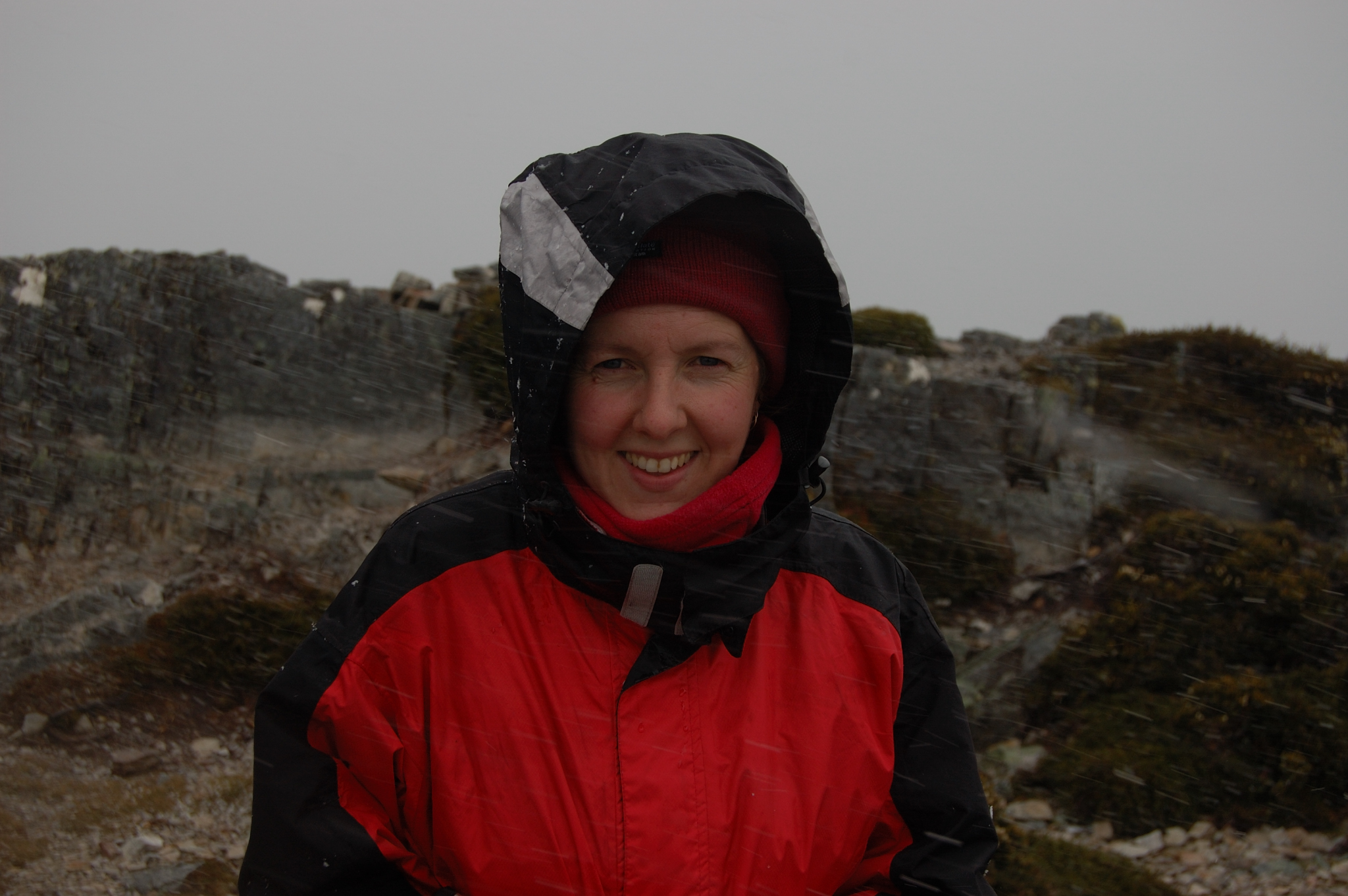
On January 1st 2009 we began the Overland in a blizzard. Our boys were ten. It was my first hike across the Cradle Mountain / Lake St Clair National Park and even though I knew Cradle Mountain was there—having climbed her a few years before—she drew her skirts close and hid in the cloud.
Two such different days!
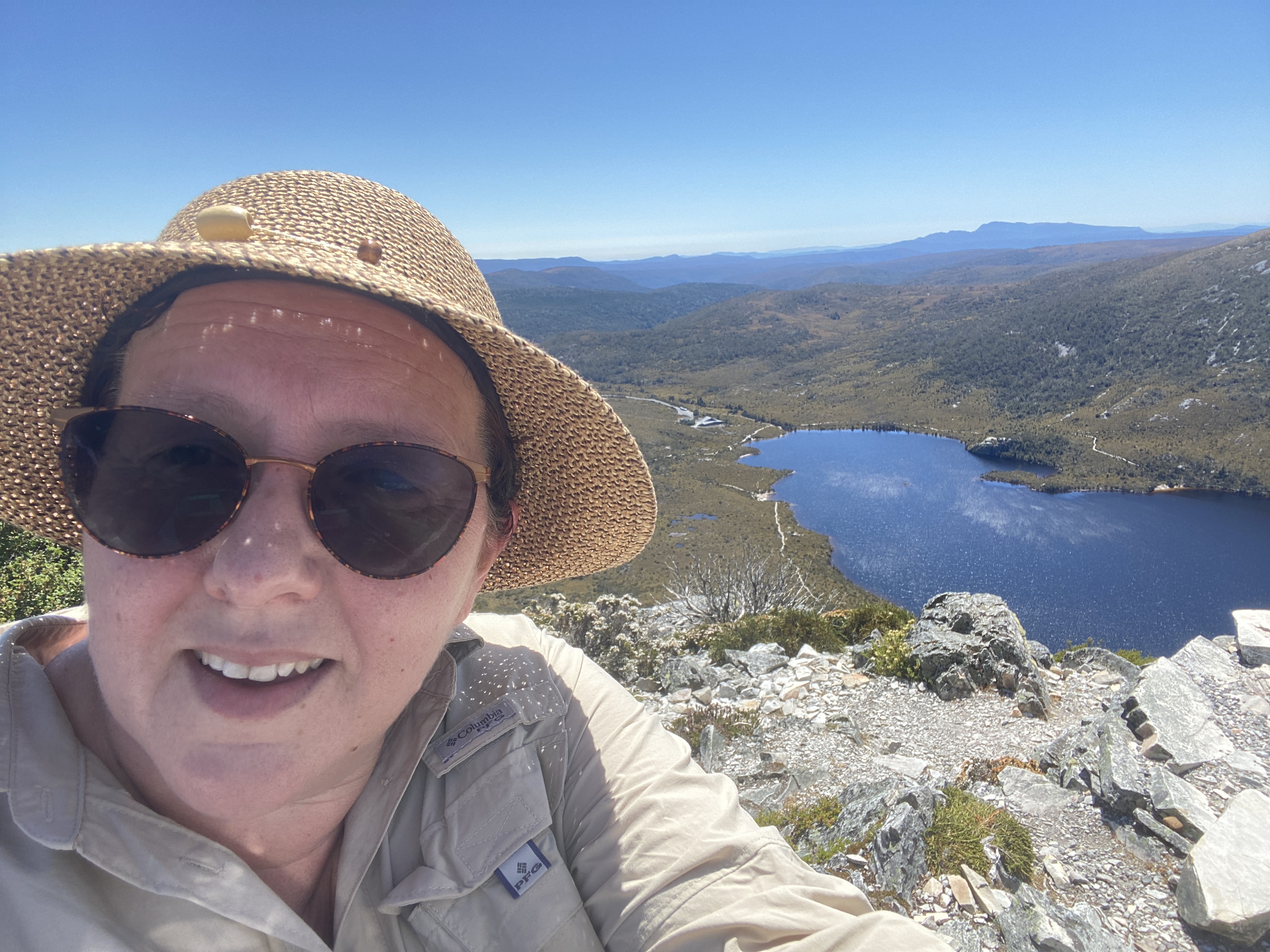
The heat certainly complicated things. The steep pinch with its full-stretch steps and chains for pulling yourself up is only part of the climb. In the full sun, what should be breathtaking become breathless.
All the same, it takes heat for the wildflowers to bloom. And bloom they do, like lace on a petticoat swaying in an occasional breeze. The Cirque is dusted in icing sugar and a drunk bumblebee attracted to the spilled cherry blossom hand sanitiser in the front pocket of Daughter’s pack follows us for some time, lured by the promise of exotic blooms and blue canvas.
I complained about hiking in the heat and gave Hubby lectures about how I am never again hiking in summer. We sat for a little while in the shade of an emergency shelter, the only shade on the west side of Cradle before the track drops down off the Cirque, making its way down into Waterfall Valley. We talked about the idea of necessary suffering.
I recently came across the phrase ‘necessary suffering’ when reading Falling Upwards: A Spirituality for the Two Halves of Life (2011) by Richard Rohr. This is a fascinating read written by a Franciscan priest whom I consider to be a wise person.
He discusses necessary suffering as that element of life required to bring out the best in us. He argues, and I agree, that without some degree of suffering, we simply remain a lesser version of ourselves. That it is suffering that refines character, that pushes and tests the personality.
I spent a lot of time on the track thinking about necessary suffering, reflecting on and refining the categories I had placed my own suffering into.
I concluded this:
The suffering that is inflicted on us or beyond our ability to control can be considered tragic suffering. Tragic suffering contains elements of grief and loss, labels the sufferer as a victim, is never something to be desired or wished on anyone, and draws compassion from those around the sufferer. There is a sense of unfairness about tragic suffering.
Tragic suffering embeds itself into the sufferer in ways that can only be healed through the choice to engage in necessary suffering.
Necessary suffering is something that is at some level, chosen.
I lived all of my thirties denying that I had had anything but a normal childhood. I recall telling a relatively new friend about my early years and in the midst of her compassionate but big reaction deciding to tell no one else. I raised my kids, started a career, moved house, was fully involved in my local church, and kept my life busy.
That is what you do when you are running from the consequences of tragic suffering.
Necessary suffering is choosing to stop running and turn and face it.
It is going to hurt. A lot. It will feel like tragic suffering, unfair and unasked for, but necessary suffering, by its nature, is fair and asked for.
Are you still with me?
I realise that I just used the words ‘suffering’ and ‘fair’ in the same sentence. Up until now, I would find that partnering of words entirely triggering. I would have argued that there is nothing fair about suffering. Nothing.
But I wonder…this is the life that I have. It is my lot, so to speak.
Isn’t it fair that I pick up my lot in life and deal with it? It is my lot, after all.
I’m not saying that my lot is fair. Goodness knows it is hardly fair that a child loses a parent to cancer, or be born with a body that is incomplete, or face life doing it tough in the many ways that kids do it tough. No. That isn’t fair.
What is fair is that it must be faced.
To walk the Overland Track, you first must book your place. Months before the season opens you are madly refreshing your browser trying to get one of the daily thirty-four spots on the track. Harder than Beyoncé tickets, you get what you get and you work around it. You have no idea what the weather will be, who else will be there, or even what will be going on in your life at that time. It is what it is.
You pick up your track pass and you start hiking on that day, no matter what.
You got the day you got. It is up to you to make the best of it. Especially if it is hot. Or snowing. Or raining sideways.
Necessary suffering is facing what you got and then making the best of it.
Facing my tragic suffering meant choosing the necessary suffering of walking through it again. I got to choose how I did this. So I chose to use my tragic suffering as part of my research into poetry. I also chose a therapist to support me. I knew it was going to be painful and that I didn’t want to do it alone. I also knew that I wanted that tragic suffering to be used for something good, to be transformed, to be something to help others, to be more than just tragic.
To live in the space of tragic suffering is to forget that necessary suffering transforms.
I was ready to quit after that first day on the track. The thing that stopped me was that I didn’t want to climb back down Marion’s Lookout.
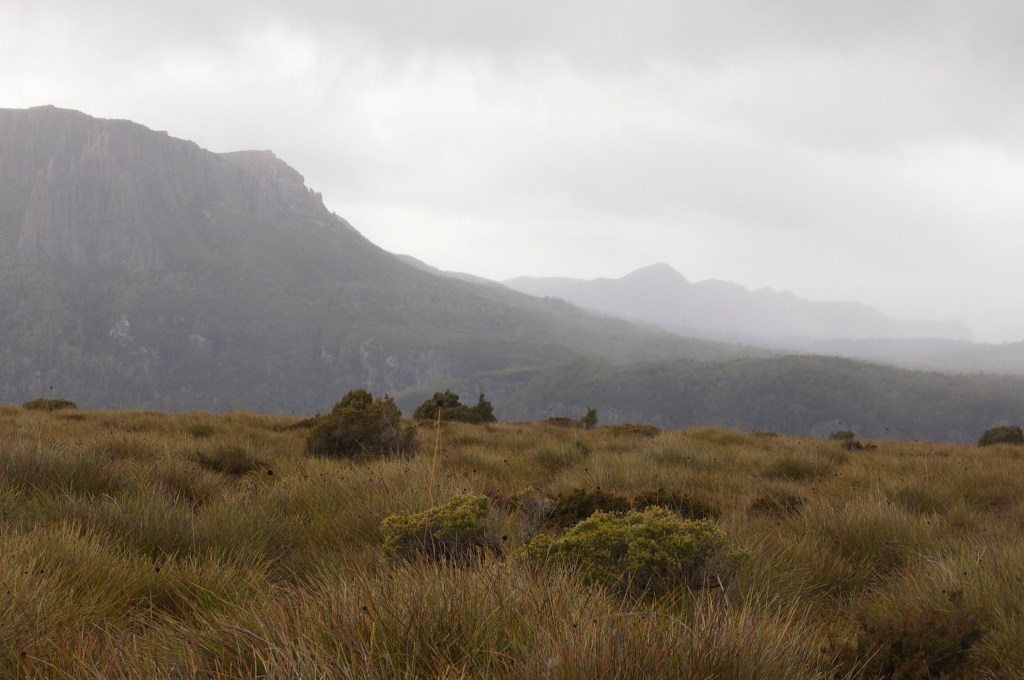
The next day the weather changed and I spent a magical few hours walking through the Button Grass moor in wild alpine wind feeling I was part of something much, much bigger than me and my suffering.

 This Writer's Life
Shell I like the phrase ‘necessary suffering’. Scottish writer George McDonald has interesting ideas on suffering that fit with what you explore too. (He got in trouble in the 1800’s for his radical ideas, as a minister). He writes of suffering being needed to bring out God’s best in us, to teach us to trust our maker fully, & to help us understand the depths of God’s love & Jesus’ sacrifice. He suggests too that our suffering can be to help those around us too. Some big ideas to wrestle with but very worth the thinking.
Glad you made it through your hike safely. Which would you prefer now: blizzard or heat on the Overland?
LikeLike
Hey bkarm, thanks for your thoughts. You have confirmed my suspicion that necessary suffering is complex and beneficial on many levels. Not that any of us wants to suffer.
I’ll take the snow! I personally find it easier to warm up rather than cool down. 😁
LikeLike