Nestled together in the tree outside my window are two spotted doves. There is a little family of them that live here in my yard. Well, there were. The mummy dove, as I imagine her to be, was taken by a cat, not ours, leaving only a pile of feathers by the water bucket.
The daddy dove and their two chicks continued to live in the lemon tree. He called for her for quite some time. Then, at some point, things changed. We cut down the lemon tree and they moved into the hedge. Then more chicks came.
It is two teenage chicks of this new generation that I am looking at now. Wet and cold, they keep watch over the chook pen, the place they break into to steal wheat and corn, and other grains. It is quite the lucrative gig they have going on.
Yesterday, I opened the chook pen gate to let one of the doves out. With a full tummy, it had gotten confused and was stuck. It’s pathetic watching the poor thing fling itself at the chicken wire to no avail.
I let the dove and the chooks out. The chooks, pleased to roam around, spent the day under the blackberry bush, scratching in the dirt. I’m hoping they cleaned up some bugs—things are getting a little out of control in the garden, given the attention being paid to the house at the moment.
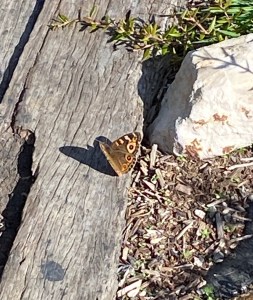
Today it is the spotted doves. Yesterday it was the Meadow Argus butterfly.
We get plenty of Painted Lady butterflies and Monarch butterflies but not usually this little guy.
It is these things, the doves, the butterflies, the lizards and bees and moths and bugs of varying degrees, that give life wonder.
That, and the ability to think.
Yesterday, in the sunshine, I sat on the back step and watched and wrote.
I wrote poems about change, told stories, and noticed life moving around me. I noticed myself writing, the hold of the pen between my fingers, and the way the ink transferred from the piece of plastic onto the page, saying something as it did.
I have been toying with learning how to use speech-to-text technology to allow me to write in the car. When no one was home, I practiced in my office, reasoning that it is better to not be driving while I learn how to use the app.
The app requires I say the punctuation. I can get used to that. It then required me to find several different apps in order to find one that would accommodate more than just saying a note. So I did that, too.
What I couldn’t do was write.
I decided my practice piece would be about the cornflower that had grown in the corner of a bed of beetroot and carrots. I wanted to make a comment on the way nature does what nature does, the way that I had planted the seeds, potted on the seedlings, planted them out, and now they were self-seeding, living beyond me. I wanted to draw parallels and remark on how things play out in unexpected and beautiful ways. Perhaps even present the idea of leaving some things untouched to allow them to be all that they can be.
None of this would come from my mouth. I simply couldn’t say it out loud.
Annoyed at the app, I put it away and went off to do something else, wondering if it was a sign that no additional time should be spent in the car.
Given my penchant for overthinking and seeing meaning in the most inanimate of objects, I pushed away any decision I might make and distracted myself with other things.
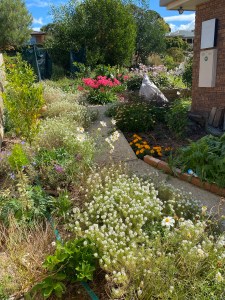
It helped that the sun was shining.
When I went outside with my notebook, it took no effort or even particular thought, my hands simply formed words on the page.
What does it mean to write? For me, it is not the same as speaking. I am inward, calm, and thoughtful when I write. I am not distracted by the sound of my voice or by the very real needs of the person I am speaking with.
Not that I ignore the needs of readers. They are simply different.
This writing—this writer—begins in my head, bypasses systems such as speech and sound, runs down my arms and is further processed by my hands. While my hands are not my head and my head is not my hands, they operate together to write.
I only introduce speech when in the final stages of editing. I read my whole thesis out loud, sentence by sentence, to ensure that it made sense. I tell my students ‘you can hear a mistake easier than you can read one’. They seem affronted being told ‘read it out loud’ but it is true. We hear several reading levels above that which we can read. That is why you should read out loud to your children, it progresses their literacy skills and is a fun, snuggly thing to do.
I diverge.
What I mean to say, the place I am going, is to ask: where in the body is the writer?
Is she only in the brain? What then of that gut feeling that proves true? Or the heart that aches with loss?
Muscle memory perhaps.
Play your favourite, most moving piece of music. It is your body that responds, not just your mind.
I love acoustic guitar. I admire the musician’s ability to bring such stirring sounds from the strings. Where is the home of this music? In his mind? In his hands? Likewise the pianist. Is it her mind that creates the music? Her heart? Her hands?
What of other artisans? From where do the drawings, paintings, sculptures, come? Why do we say that something comes from the heart?
The seat of consciousness is debated by many but known by none. Religion tells us we have a soul. Science says a mind.
And what of the Jungian concept of synchronicity?
Yesterday, I pondered how it was that my hands write while my mouth cannot. Today, I came across a TED talk questioning the constants of science. This video, amongst other things, touches on the concept I had been considering—is the mind limited to the brain?
I have no answers. Just questions. Just like Robert Sheldrake in his TED talk HERE.
By the way, TED took this video down. They didn’t like the way he used science to question the beliefs of science. Gotta love me some science drama.

 This Writer's Life